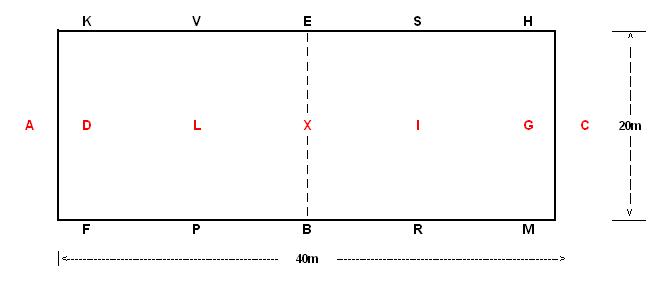
The Dressage Arena Every rider from Novice to highly experienced, whether training or performing will be faced with a variation of the following ‘enclosure’ either on a 60m x 20m or 40m x 20m design:
The ‘A’ and ‘C’ sides being 20m and the longer sides being the 60m or 40m (in this case) - note the above diagram is NOT to scale, purely for layout purposes! The entrance is on the short side and the corners if outside are very often decorated with tubs of flowers or shrubs to make it pleasanter on the ‘eye’ although it has to be said some horses can take a strong dislike to such adornments!! The novice horse will be trained to walk and trot in a straight line down each side keeping absolutely parallel with the side of the arena, to turn at M,H,K or F across the school passing through X to the diagonally opposite side of the arena respectively K, F, M, or H and if in competition or test will be marked on how straight the path is taken by the horse and rider. Next there will be training on 20m circles, that is the whole width of the arena with the centre at I or L in the case of a 40m length or a little between G and I or D and L in the case of this 60m arena. Dressage training is a very slow process especially with a young horse as it will be very reluctant in the first instance to do what the rider requires of it – PATIENCE is the number one virtue and a lot of time. One simple way to start is on what is known as the lunge rein which will be about 10m long to accustom the horse to this distance and it is gently persuaded to go round this circle using a lunge whip, NOT to strike the horse it should be stressed but to remind it that there is encouragement should it require it! Assuming the horse is already broken-in, the trainer or an experienced rider may mount the horse and work with it still on the end of the lunge rein gradually decreasing the radius towards 5m to give a 10m circle or half the arena, this not only accustoms the horse to this work but also to having a rider encourage it to do the work – if on the other hand other outcomes are sought such as show-jumping or three-day eventing, then the use of such training aids as trotting poles spaced evenly on the ground are a useful exercise, but it should be emphasised that the ‘dressage’ work should be continued whatever the expectancy. As the horse progresses with it’s training it will be desirable to begin tests even of a non-scored variety to check its abilities and there are numbers of books which give basic routines for a rider to perform to test theirs and the horse’s abilities, in simple terms given the basic layout of the arena, entrance is at A and in competition there will be judges at H, C and M since just one judge cannot observe all the gaits around the arena. As with so many physical sports progress will at times be agonisingly slow, other times great strides forward, and it should be pointed out this is not a treatise for the experienced rider but rather a taster for a beginner who may be considering taking up the art, or perhaps needs the experience and/or discipline of some basic dressage to improve their other riding skills. Experienced riders have their own particular tips and methods to achieve mutually satisfactory performance of Horse and Rider in the arena, and most are more than willing to share their experiences and tips with a novice who they see is both keen and capable. |