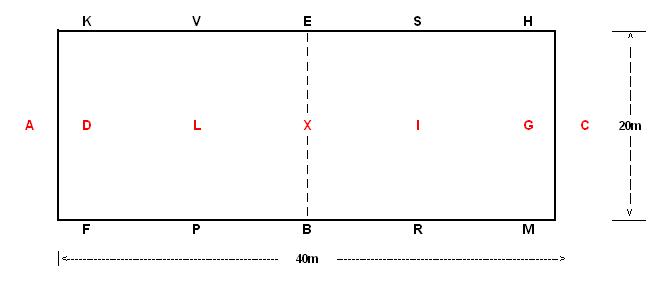
The Dressage Rider: Anyone who is truly interested in riding has the potential to be a Dressage Rider, whether they have the necessary application and perhaps the financial backing (personal or sponsorship) is another matter. If you are new to the art then there is a requirement at least at the outset to get yourself a trainer who knows the basic minimum to guide you in what you propose setting out to achieve. Dressage consists of a sequence of manoeuvres on horseback around and across an arena, the 40m x 20m standard arena is shown below: The Basic 40m x 20m Arena: (Not to scale)
There are a number of basic qualities desirable in the rider – PATIENCE, calm, determination, a reasonable memory for the course you are supposed to be following, and last but not least a good seat when mounted on your horse. One of the more tiring exercises to obtain this ‘good’ seat is to ride walk, trot and rising trot without stirrups, apart from leaving a tired backside, it does settle the rider well-down into the saddle, and the muscles that develop in the leg stand one in very good stead later as more control is required. Every experienced rider has their own ‘take’ on how to proceed, it is not a bad idea to start a novice rider with an ‘experienced’ horse in the sense that it is able and willing without too much exertion to undertake basic manoeuvres of walk, trot, rising trot and canter and perhaps circle in half the school (20m) anything more advanced is going to require definite rider input. As the rider develops musculature and experience, if the existing animal is unsuitable to proceed any further, two possibilities exist – a more experienced horse which WILL require ‘driving’ to undertake the more advanced manoeuvres and so the rider gains experience, or a new horse and rider combination training together to achieve ultimate success as a shared experience, this requires a greater degree of skill and knowledge of the trainer, but can be immensely rewarding for all concerned. At some point everyone must decide where all this hard work is leading –
Dressage and riding in general is one of those sports which is tremendously demanding on both horse and rider to be truly satisfying if the desired levels are achieved, but it should be emphasised again this is to provide a taster of the expectancy rather than an instruction manual of do’s and don’ts. |